Showing posts with label exercise in PD. Show all posts

Sunday, April 8, 2012

REGULAR EXERCISE, THE FIFTH WAY TO BEAT PD

Through the words of the Holy Bible, the Greatest Book ever written in the world, you will find the answer to your greatest need, the miracle of healing in THE FIFTH WAY to beat Parkinson's disease.


"Easter Bunny"
From an original painted with the mouth by A. Sapinska


 EXERCISE REGULARLY


 " Train yourself for devotion, for, while physical training  is of limited value, devotion is valuable in every respect, since it holds a promise of life both for the present and for the future. "
          
                                                                                                     1 TIMOTHY 4: 7-8


Regular exercise in Parkinson’s Disease is recommended since it plays a key role in helping to manage many of the primary and secondary symptoms of Parkinson’s disease. It typically includes strength training, stretching, and aerobic activities. A rehabilitation medicine specialist can also recommend the exercise regimen suited for every PD patient.

You must have a consistent exercise program, based on your ability level. It should be incorporated into your treatment regimen in order to maintain flexibility, mobility, and general well-being. You can develop an exercise program on your own or with a physical therapist. Others find that attending general or PD-specific exercise classes is also helpful.

Regular exercise improves mood, raises your self-esteem, and gives you a better body image. It also elps lessen stress and improves general body function by increasing your muscle tone, strength, and endurance. It also provides better sleeping patterns as well as increased confidence and a more positive attitude to life.

Find an exercise activity or program that you can stick with, or visit your local gym and enrol in a class. This is your chance to take a dancing lessons or learn yoga. Commit to maintaining and improving your health so as to improve your quality of life and to slow down the progression your PD symptoms.


http://www.youtube.com/watch?v=23ctmPTwgGY&feature=player_embedded#!


It is important that in every exercise regimen, you have the right breathing technique. Breathing is a body function that you do unconsciously at every moment but to be able to maximize the benefit of regular exercise, it should be done via a three-part breath or the diaphragmatic breathing.


In diaphragmatic breathing, you sit tall or lie comfortably on your back. You place one hand on your chest just below the collar bones and the other hand on your abdomen. Inhale through your nose and feel your hand on your abdomen rise first followed by the hand on your chest. On exhale, expel the air from your chest first, then your rib cage and finally your belly. If you feel light headed or dizzy at first, stop and breathe normally and then resume. Practice until you get used to this new way of breathing.

Monday, April 2, 2012

4 WAYS FOR HEALING OF PARKINSON'S DISEASE

Healing of any illness like Parkinson's disease or PD is possible through G-MEN (GOD, MEDICINE, EXERCISE and NUTRITION).

"I urge you therefore, brothers, by the mercies of God, to offer your bodies as a living sacrifice, holy and pleasing to God, your spiritual worship. Do not conform yourself to this age but be transformed by the renewal of your mind, that you may discern what is the will of God, what is good and pleasing and perfect...Let love be sincere; hate what is evil, hold on to what is good; love one another with mutual affection; anticipate one another in showing honor. Do not grow slack in zeal, be fervent in spirit, serve the Lord. Rejoice in hope, endure in affliction, persevere in prayer."      
                                                                     
                                                                                 ROMANS 12: 1-2, 9-12

1. ADOPT A POSITIVE ATTITUDE IN LIFE

 " Therefore I tell you, do not worry about your life, what you will eat [or drink], or about your body, what you will wear. Is not life more than food and the body more than clothing? Look at the birds in the sky; they do not sow or reap, they gather nothing into barns, yet your heavenly Father feeds them. Are not you more important than they? Can any of you by worrying add a single moment to your life-span?... Do not worry about tomorrow; tomorrow will take care of itself."
                                                                               
                                                                                 MATTHEW 6: 22-27, 34

Look at your illness as a gift or a blessing. It will open your eyes to the truth that you have been living your life for the past years without any real sense of direction. You're always worried about paying the bills, wondering what to wear, organizing an event or planning a great future for your family that you never really stopped and enjoyed the beauty of creation around you. You've always been busy and never slackened your pace even if your body has already shown signs of exhaustion. Perhaps, you might have had a near fatal accident but it didn't slow you down but only made you more careful. It has taken the diagnosis of Parkinson's disease to wake you up that you're taking on too much to handle and perhaps taking a lot of other things for granted, too. Now is the time to savor the tranquility of your surroundings, smell the flowers, walk the dog and spend more time with your family. Start to live for the moment rather than worry about tomorrow.

2. ACCEPT THE DOCTOR'S ROLE

"Hold the physician in honor, for he is essential to you, and God it was who established his profession. From God, the doctor has his wisdom...His knowledge makes the doctor distinguished...God makes the earth yield healing herbs which the prudent man should not neglect...He endows men with knowledge to glory in his mighty works, Through which the doctor eases pain and the druggists prepares his medicines;...My son when you are ill, delay not, but pray to God, who will heal you;...Then give the doctor his place, lest he leave, for you need him too. There are times that give him an advantage, and he too beseeches God That his diagnosis may be correct and his treatment bring about  a cure."
                            
                                                                         SIRACH 38: 1-4, 6-7,9, 12-14

Parkinson’s Disease is a disease that mostly affects middle-aged and elderly people characterized by a hallmark of four cardinal symptoms, namely, resting tremors, postural instability, muscle rigidity and slow movement (RPMS). For those who developed the onset of PD between 21-40 years old, you have what is termed the Young-Onset Parkinson's Disease (YOPD).

You may have overlooked the early signs and symptoms because they are subtle and the progression of the disease is gradual or typically slow. PD is both chronic and progressive. It may persist over a long period of time and the symptoms grow worse over time. Its definite cause has not been identified. It is probably multifactorial but the following factors have been implicated like hereditary predisposition or genetics, environmental toxins, aging, infectious diseases (meningitis), head trauma (boxing)and drugs.

Your physician will give a diagnosis of PD based on several factors such as signs and symptoms, your medical history, physical examination, and a thorough neurological evaluation. He will refer you to a neurologist or movement disorder specialist who will perform a comprehensive overview of the major non-motor complications that are often associated with Parkinson's disease, which includes cognitive impairment, dementia, psychosis, depression, fatigue, sleep disturbances, constipation, sexual dysfunction and vision disturbances.

There is no definite cure for Parkinson’s at present. The first line of treatment of Parkinson's disease is still medical like intake of levodopa which provides the dopamine, the neurotransmitter lacking in PD. Surgical treatment of PD has been reserved only for patients with both severe motor impairment from PD and motor complications in the form of fluctuations and dyskinesias. Your physician will present the appropriate management for you and it will be up to you to choose. Aside from the standard treatments, there may be other treatment options available to you like the complementary and alternative medicine (CAM) that you can discuss with your neurologist which will be critical to better control your symptoms and preserve  your overall functional capacity and quality of life.

Read more: http://pinoyparkinsonsdisease.blogspot.com/


P.S. If you need help and support in your PD, subscribe for FREE.


P.P.S. Get FREE updates and news on upcoming activities of Pinoy PD.


P. P.P.S. Avail of FREE MEMBERSHIP to Pinoy PD until April 30, 2012.


Submit your NAME and EMAIL address to:
pinoyparkinsonsdisease@gmail.com

Monday, October 31, 2011

HEALING OF PARKINSON'S DISEASE THRU YOGA

Yoga is a 5000 year old practice which involves the physical, mental and spiritual discipline originating in ancient India. The goal of yoga, or of the person practicing yoga, is to achieve a state of perfect spiritual insight and tranquility. It is associated with meditative practices in Hinduism, Buddhism and Jainism.

Within Hindu philosophy, the word yoga is used to refer to one of the six orthodox (āstika) schools of Hindu philosophy. Yoga in this sense is based on the Yoga Sutras of Patanjali, and is also known as Rāja Yoga to distinguish it from later schools. Patanjali's system is discussed and elaborated upon in many classical Hindu texts, and has also been influential in Buddhism and Jainism. The Bhagavadgita introduces distinctions such as Jnana Yoga ("yoga based on knowledge") vs. Karma Yoga ("yoga based on action"). Other systems of philosophy introduced in Hinduism during the medieval period are Bhakti Yoga, and Hatha Yoga.

Yoga (Devanagari:योगा) ) is also a term for a range of traditional systems of physical exercise and meditation in Hinduism.

Modified versions of the physical exercises in Hatha Yoga have become popular as a kind of low-impact physical exercise, and are used for therapeutic purposes. "Yoga" in this sense, in common parlance, refers to the physical exercises, i.e. the asanas or postures. Aspects of meditation are sometimes also included.

Both the meditative and the exercise components of yoga show promise for non-specific health benefits. According to an article in the Journal of Alternative and Complimentary Medicine, the system of Hatha Yoga believes that prana, or healing "life energy" is absorbed into the body through the breath, and can treat a wide variety of illnesses and complaints.

Yoga has also been studied as an intervention for many conditions, including back pain, stress, and depression. A survey released in December 2008 by the US National Center for Complementary and Alternative Medicine found that yoga was the 6th most commonly used alternative therapy in the United States during 2007, with 6.1 percent of the population participating. The physical asana of Hatha Yoga have a tradition that goes back to the 15th century, but they were not widely practiced in India prior to the early 20th century. Hatha Yoga was advocated by a number of late 19th to early 20th century gurus in India, including Sri Krishnamacharya in south India, Swami Sivananda in the north, Sri Yogendra in Bombay, and Swami Kuvalyananda in Lonavala.

In the 1960s, western interest in Hindu spirituality reached its peak, giving rise to a great number of Neo-Hindu schools specifically advocated to a western public. Among the teachers of Hatha yoga who were active in the west in this period were B.K.S. Iyengar, K. Pattabhi Jois, and Swami Vishnu-devananda, and Swami Satchidananda.  A second "yoga boom" followed in the 1980s, as Dean Ornish, a follower of Swami Satchidananda, connected yoga to heart health, legitimizing yoga as a purely physical system of health exercises outside of counter culture or esotericism circles, and unconnected to a religious denomination.

Since then, yoga has been used as supplementary therapy for diverse conditions such as cancer, diabetes, asthma, and AIDS. The scope of medical issues where yoga is used as a complementary therapy continues to grow including Parkinson's disease. This can be demostrated in the recently concluded First Annual Convention of Pinoy Parkinson's Disease (Pinoy PD) in Makati City, Philippines last October 22, 2011.


There are many different styles and disciplines and people practice yoga for a variety of reasons. One of the main goals of yoga is to improve overall well-being through teaching discipline and self-regulation. Recently, research has focused on the healing properties of yoga and how it relates to positive psychology. Researchers wonder what psychological advantages it can afford, in addition to the previously discovered physical benefits. Yoga has proven to offer different and multiple benefits for individuals ranging from consciousness of one's body and its capabilities, satisfaction from challenging oneself physically, and increased energy and mental clarity and concentration. While the topic is still somewhat new and some research is still preliminary, results have shown significant improvements in both physical and mental health among a variety of subjects in various circumstances.

The practice of yoga traditionally includes both meditation and exercise, but in the West the focus is mainly on exercise. The more classical approaches, such as Iyengar Yoga, move at a more deliberate pace, emphasize proper alignment and execution, hold asanas for a longer time. They aim to gradually improve flexibility, balance, and strength. Other approaches, such as Ashtanga or Power Yoga, shift between asanas quickly and energetically. And more recently, contemporary approaches to yoga have developed [(such as Scaravelli inspired, as taught by the likes of Diane Long, Sophie Hoare and Marc Woolford )], inviting students to become their own authority in yoga practice by offering principle based approaches to yoga that can be applied to any form.

Nearly all types of yoga practices include asanas (postures), pranayama (breathing exercises), and savasanas (relaxation techniques).


                                                                            Emily Slonina

In a book by Emily Slonina, "Anywhere, Anytime and Any Body Yoga", she discussed the simple yoga principles that one can use and incoporate in everyday ordinary activity like sitting in a chair, working at the office, lying on the bed, traveling, standing and even doing household chores. For someone too busy or with limited agility or flexibilty, the book has been designed as a practical guide that one can utilize without taking too much time, planning and effort. Breathing exercises, anytime neck and shoulder de-stressers, warm-ups, chair yoga poses like sun and moon salutation and relaxation-meditation are presented complete with instructions and illustrations. Even the models Ms. Slonina used in her book are not the typical folks but are differently-abled.


Saturday, October 29, 2011

THE FIRST PINOY PD CONVENTION, A SUCCESS!


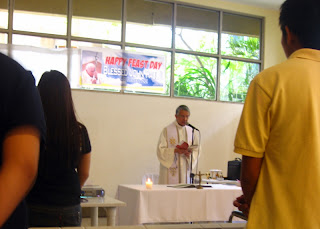
The first annual convention of the Pinoy Parkinson's Disease (Pinoy PD) on Healing of Parkinson's Disease thru G-MEN (God, Medicine, Exercise and Nutrition) has been successfully launched last October 22, 2011 at the Multi-purpose Hall, Paseo Parkview Suites, Makati City. It was also the Feast Day of Blessed John Paul II.


Father Joey Paras, SDB, officiated the Thanksgiving Mass with Miss Rowena Bicaldo as Lector while the trio of Eufe and Mary Rose Tantia and Marie Ness Cabahug led the choir.  In his homily, Fr. Paras emphasized the virtues of Blessed John Paul II and the latter's love for the Blessed Virgin Mary. He said that the family and the caregivers of those with Parkinson's disease were in a privileged position because they can see the face of Jesus everyday in the face of those suffering from PD.


His Excellency, Most Reverend Patricio A. Buzon, SDB, and Chairman of the Episcopal Commission on Health Care conveyed his inspirational message from the Diocese of Kabankalan, Kabankalan City, Negros Occidental. He stated that the healing of Parkinson's disease resides in God and in Man. "God is the source of life. Life is a gift from above. Man is also another source of healing. Life is also a responsibility. We have our own part to play for healing to happen. The human counterpart of healing is thru MEN - Medicine, Exercise and Nutrition. Do your part and God will do His."


Brother Michael Angelo F. Lobrin gave an animated talk on Spiritual Healing of Parkinson's Disease. He is a graduate of Bachelor of Arts, Major in Classical Philosophy in San Carlos Seminary Guadalupe. He has obtained units in Master of Arts in Theology from the same institution.  He was a professor of Theology at the De La Salle University, Manila Doctors College and St. Paul University, Quezon City.  He is currently a professor of Philosophy at the Entrepreneur School of Asia in Quezon City and serves as Adviser for Religious Affairs to a number of local and national politicians.  Brother Michael is – in more ways than one – a prolific and sought-after inspirational speaker.  He is also the best selling author of “Laugh with God Today!”

After his talk, Brother Michael Angelo prayed over those with Parkinson's disease. He also loaned the relic of Blessed John Paul II so the participants of the convention can touch it after reciting the "Prayer for Healing of Parkinson's Disease through the Intercession of Blessed John Paul II.


Read more ....www.pinoyparkinsonsdisease.blogspot.com

Saturday, September 17, 2011

HEALING OF PARKINSON'S DISEASE THRU G-MEN (GOD, MEDICINE, EXERCISE AND NUTRITION)

As we approach the Feast Day of Blessed John Paul II on October 22, 2011, we are reminded that we are just six weeks away from the main event in the life of a Filipino with Parkinson's disease or a  PINOY PD, i.e, the "HEALING OF PARKINSON'S DISEASE THRU G-MEN (GOD, MEDICINE, EXERCISE AND NUTRITION), the First Annual Convention of Pinoy PD slated in Makati City on the same day.


For the past three weeks, I have discussed some of the gifts and fruits of the Holy Spirit by quoting the Scriptures from the Holy Bible. I have also tackled one of the medications commonly used as a first line treatment for Parkinson's disease which is levodopa based on its content, indication, dosage, administration, contraindication, special precaution, adverse reaction, drug interaction, preparation and price. I have also enumerated some of the benefits of regular exercise for the person with  Parkinson’s disease, the general recommendations on how to get started, the  general safety measures as well as the target of an ideal exercise program.


As a fitting introduction to one of the key resource speakers in the upcoming event, I have requested Ms. Nona Lema, a vegetarian and meditation expert, to be my guest writer for the next 3 weeks. It will be a 3-part article series on "How Can A Vegetarian Diet Be of Help To PD Patients?"


The First Annual Convention of Pinoy PD aims to  impart a general knowledge on the diagnosis and holistic management of Parkinson’s Disease (PD) among Filipinos through G-MEN (God, Medicine, Exercise and Nutrition).


Below are the Programme  and Venue details:


If you want to take part actively in the said convention, please register and submit your details ASAP.


P.S. Register for FREE (including lunch, 2 snacks, seminar kit) on or before September 30, 2011.


P.P.S.  Get a GUARANTEED SEAT and SLOT to the workshop to a LIMITED NUMBER of participants if you register on or before September 30, 2011.


P.P.P.S. Send your registration details via e-mail: drajoy31@gmail.com / drajoy31@yahoo.com on or before September 30, 2011 to be counted.


Tuesday, September 13, 2011

HEALING OF PARKINSON'S DISEASE THRU EXERCISE


Exercise plays a key role in the management of Parkinson's disease (PD). If done regularly, it may slow down the progression of the disease. It usually includes stretching, strength training and aerobic activities. An exercise program should be individualized and should be based on the patient's ability level so as to maintain flexibility, mobility and general well-being. It is usually recommended by the rehabilitation specialist who works hand in hand with a physical therapist.


Dr. M. Schenkman, et. al, did a a randomized, controlled trial in 1998 at the Duke University  Medical Center in Durham, North Carolina, USA, on how exercise can improve spinal flexibility and function for people with Parkinson's disease. The study showed improvements in axial mobility and physical performance within a 10-week exercise program for people in the early and midstages of PD.


In another study done by Dr. Victur Lun, et.al, in 2005, the effects of a self-supervised home exercise program were compared with the effects of a physiotherapist-supervised exercise program on the motor symptoms of Parkinson's disease. There was note of a statistifically significant improvement on the motor symptoms for both programs with similar effectiveness.


The above findings are important in the counseling of PD patients regarding adjunctive treatment of motor symptoms of PD with exercise. 


Some of the benefits of regular exercise for the person with Parkinson’s disease are as follows:
 Improved control over gross motor movements, such as walking
 Increased muscle strength and flexibility
 Increased cardiovascular fitness
 Improved coordination and balance
 Improved posture
 Reduced muscle cramping
 Greater confidence in performing daily activities
 Reduced stress levels
 Improved joint mobility


General recommendations on getting started are the following:
 Spend at least 15 minutes of exercise every day.
 A thorough stretching program that targets each joint and muscle group is recommended.
 Warm up and cool down for a few minutes like marching in place or stretching.
 Begin with the easiest exercises first and slowly perform the more difficult exercises as your
fitness increases.
 Try to execute each movement to the best of your ability.
 Stop and rest if you get tired at any point during your exercise program to prevent worsening of
your symptoms.
 Stop performing any exercise that causes you pain.
 If you get tired easily, try exercising earlier in the day.
 Try to make exercising fun by exercising with others or playing your favourite music.


If you are at risk of falling or freezing (sudden inability to move), general safety suggestions include the following:
 Sit down when you do your exercises.
 Grab a chair when performing standing exercises.
 Avoid floor exercises if you can’t get up by yourself.
 Don't exercise alone even at home so you can ask help if necessary.
 Exercise with others.
 Call for assistance from a family member or friend.


Aim to build up to 8–10 repetitions of each exercise. Ideally, the exercise program should target the following:
 Overall fitness
 Muscle flexibility
 Legs
 Head and shoulders
 Arms and torso
 Face
 Hands and wrists


References:


1. Movement Disorders Volume 20, Issue 8, pages 971–975, August 2005
2. J Am Geriatr Soc. 1998 Oct;46(10):1207-16.